The technology
The Scheffel
self-steering bogie.
Fifty years of refinement. Thousands of revenue-service axles. The single largest contribution South African rail engineering has made to heavy-haul economics — and one of the quietest decarbonisation levers the industry has.
- 0%
- Rail savings on curves
- 0%
- Wheel-wear reduction
- 0%
- Fuel reduction
- 0%
- Maintenance cycles down
- 0+
- Years of refinement
- 0
- Year of original work
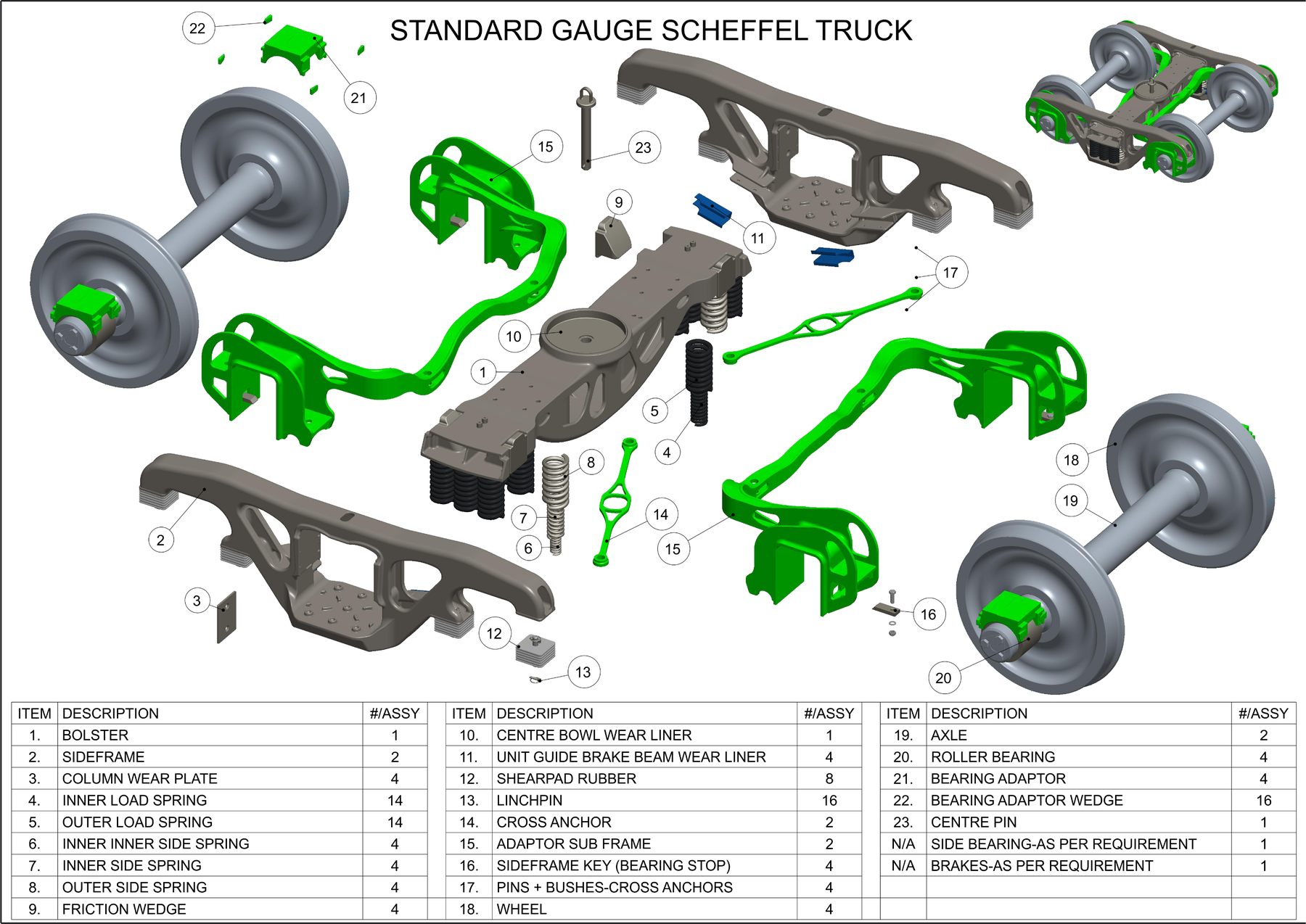
Exploded view · Standard-gauge HS Scheffel truck — every component numbered against the assembly schedule.
What it actually does
Four levers,
pulled at the same time.
-
Wheels
Wear, dramatically reduced
Self-steering wheelsets align themselves to the rail through curves — eliminating the cyclic flange contact that destroys conventional wheel profiles. Result: profiles last multiples longer.
-
Rails
Lower lateral forces
The bogie negotiates curves without the lateral hunting that abrades rail heads. South African heavy-haul corridors were the proving ground; the same physics works on any narrow-gauge network.
-
Fuel
Less rolling resistance
When the wheelsets aren't fighting the track, the train doesn't fight the locomotive. 5–10% fuel savings on revenue-service trains, every trip.
-
CO₂
Decarbonisation, quietly
No new technology, no battery retrofit — the bogie design itself drives the emissions reduction. Sustainability that compounds across every kilometre run.
"Scheffel bogies are the heartbeat of the South African railway industry — and our solutions can directly contribute to sustainable rail goals.
Bring Scheffel to your fleet.
New build, retrofit, refurbishment — get a written assessment from our engineering team.
Talk to engineering